Fair Game launches Online Harms report
New report reveals online abuse is a “systemic safeguarding issue” across all levels of football
· New Fair Game Online Harms report warns that online harms in football are impacting people’s wellbeing and damaging participation.
· Report calls for a coordinated, preventative strategy built around five priorities and calls for that digital spaces should be treated with the same seriousness as physical environments.
· Incidents of online abuse are increasingly prolific, affecting everyone from grassroots volunteers all the way up to elite professionals in the men’s and women’s game.
· Through its global reach and cultural influence, football has a unique opportunity and responsibility to lead by example in tackling online harms.
A new report from Fair Game has concluded that online harms in football have become a widespread safeguarding, wellbeing and participation issue impacting people from all levels of the game.
Supported by the All-Party Parliamentary Group for football, the Online Harms in Football report reveals that online abuse is no longer confined to social media spats or high‑profile flashpoints and recommends that the sport desperately needs to overhaul the way it protects people in digital spaces.
The report, which draws on the 2026 APPG for Football inquiry into Online Harms, finds that online abuse is no longer a peripheral social‑media problem but “a routine condition of modern football, shaping experiences across all levels of the game and extending far beyond players, affecting referees, journalists, coaches, volunteers, supporters, club staff, administrators and governing bodies.”
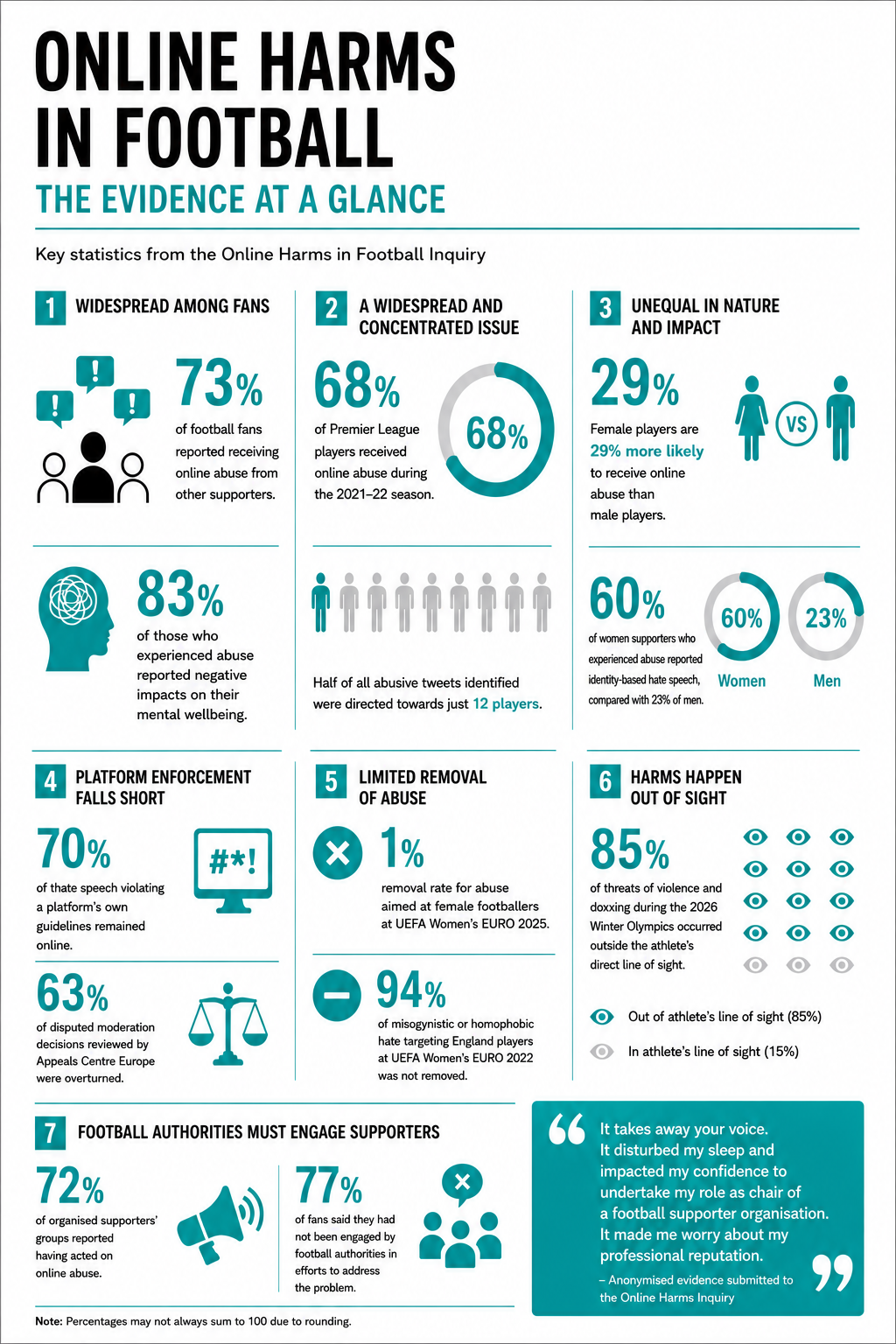
Although increasingly widespread, the inquiry also shows that much of the activity is concentrated to a targeted audience, with half of all abusive tweets sent to Premier League players.
Key Findings
1. Online harms affect the whole football community
The inquiry found that abuse touches every role in the game. Yet the ability to respond varies dramatically. Many lower‑league and grassroots clubs lack dedicated safeguarding staff, leaving individuals to manage abuse alongside other responsibilities. This creates emotional strain, inconsistent protection and unequal access to support.
2. The scale of abuse hides the scale of harm
Although abusive posts may represent only 0.5–1% of online football discussion, harm is highly concentrated. Half of all abusive tweets sent to Premier League players in the 2021–22 season targeted 12 individuals. The report warns that coordinated pile‑ons, repeated exposure and identity‑based targeting pose serious risks.
3. Women, minoritised groups and disabled participants face disproportionate abuse
Female players are 29% more likely to receive online abuse than male players. The inquiry highlights the prevalence of misogynistic, racialised, sexualised and homophobic attacks, noting that “a uniform understanding of ‘online abuse’ cannot adequately capture how harms are experienced across football.”
4. The consequences extend far beyond social media
Online abuse affects mental health, professional performance, family life, confidence and retention. Athletes report impacts on concentration and willingness to engage publicly, while journalists describe self‑censorship to avoid backlash. Volunteers and administrators often step away from roles entirely.
5. Normalisation and weak enforcement discourage reporting
Abuse is widely seen as “part of the job”, leading to under‑reporting. Fans surveyed showed that 73% had received online abuse from other supporters, yet nearly half did not report it. Inconsistent platform enforcement further erodes trust.
6. Too much responsibility falls on victims
Targets are often expected to identify, document and report abuse themselves. The inquiry argues that safeguarding must shift from individual burden to organisational responsibility, with clearer accountability across football authorities, clubs, platforms and government.
A New Approach: The STEP‑UP Framework
The report calls for a coordinated, preventative strategy built around five priorities:
· Recognise online harms as a safeguarding issue
· Establish clear accountability and minimum standards
· Strengthen organisational readiness
· Move from reactive intervention to prevention
· Build a coordinated football‑wide response.
These principles underpin the STEP‑UP framework: Support, Training, Education, Policy, Unite and Positive Culture, offering practical guidance for clubs and governing bodies.
A Call to Action
The inquiry concludes that football must treat digital spaces with the same seriousness as physical environments. As the report states, “those participating in the game should be afforded the same expectation of safety within the digital stadium as they are within the physical one.”
With football’s global reach and cultural influence, the sport has a unique opportunity and responsibility to lead by example in tackling online harms.
Josh Bland, Director of Research at Fair Game said: “Football has an enormous cultural and global reach and that gives the sport a responsibility to lead by example.
“Online harms are no longer a side‑issue in football, they shape how people experience the game at every level.
“The amount of targeted hostility received by individuals is simply incompatible with a safe and healthy football environment. All of this demands a safeguarding response, not a shrug of inevitability.”
The Online Harms in Football report and Executive Summary are accessible here
The Online Harms in Football report was authored by Jack Black, PhD, Associate Professor of Culture, Media and Sport, Sheffield Hallam University; Thomas Fletcher, PhD, Professor of Sociology of Sport, Leeds Beckett University; Emma Kavanagh, PhD, Reader in Sports Psychology, Loughborough University; Daniel Kilvington, PhD, Professor of Media and Culture, Leeds Beckett University.
Fair Game is the Secretariat for APPG for Football.